The Update That Sounds Like an Ending
Keep an ongoing news story open in your notes: separate confirmed updates from unanswered questions so a fresh development does not become a false ending.
You read that a council has paused a controversial plan, close the tab, and tell a friend the plan is off. The next day, a new report says officials will reconsider it. Keeping an ongoing news story open in your notes helps prevent that first update from becoming the final account in your mind.
A fresh development can be important without settling what happened or what will happen next. The practical task is to record the change while keeping its limits visible. A notebook, a plain text file or a notes app is enough; what matters is the distinction between a new fact and a finished story.
What has actually changed?
Start by describing the update in one neutral sentence. Keep the wording close to what the report says, and name the action or event rather than its apparent meaning. “The council paused the plan pending a review” is more useful than “The council abandoned the plan”. The second sentence turns a pause into a decision the report may not support.
Then identify what is new compared with the account you already had. An update may add a decision, a response, a document, a change in timing or simply a fresh description of an earlier event. If it adds no new information, note that too: a new article is not necessarily a new development.
Write down the source and when the update appeared. If the report refers to a meeting, statement or document, record that reference as well. This makes it easier to distinguish the event itself from the publication that brought it to your attention.
- New event: something has happened since the previous account.
- New detail: a source has supplied information about an event already reported.
- New interpretation: a reporter, official or commentator has explained what an existing fact might mean.
- Repetition: the story has circulated again without a clear new fact.
These categories can overlap, but naming the main change keeps your note from quietly turning interpretation into evidence.
Which words make the story sound settled?
Next, notice the words that imply completion. “Scrapped”, “resolved”, “cleared” and “ruled out” can describe definite outcomes, but they may also appear in a headline that compresses a more qualified account. Check the body of the report for the actual decision, its scope and any stated conditions.
Pay particular attention to verbs of intention and process. “Will review”, “plans to consider” and “has begun an inquiry” describe different stages from “has decided”. A proposed action is not the same as a completed one; a review beginning does not tell you what it will conclude.
Also watch for endings supplied by narrative shape. A report may open with a dispute, introduce a striking development and finish with a response. That can make the account feel complete even when the response leaves the central question open. Treat the article’s stopping point as an editorial boundary, not necessarily the story’s endpoint.
What remains unknown after the update?
Before you look for more coverage, write a short list of open questions. Make each one answerable in principle, rather than asking for a vague sense of “what is really going on”. Useful questions concern what has not yet happened, what evidence is still missing and which decision-maker has not spoken.
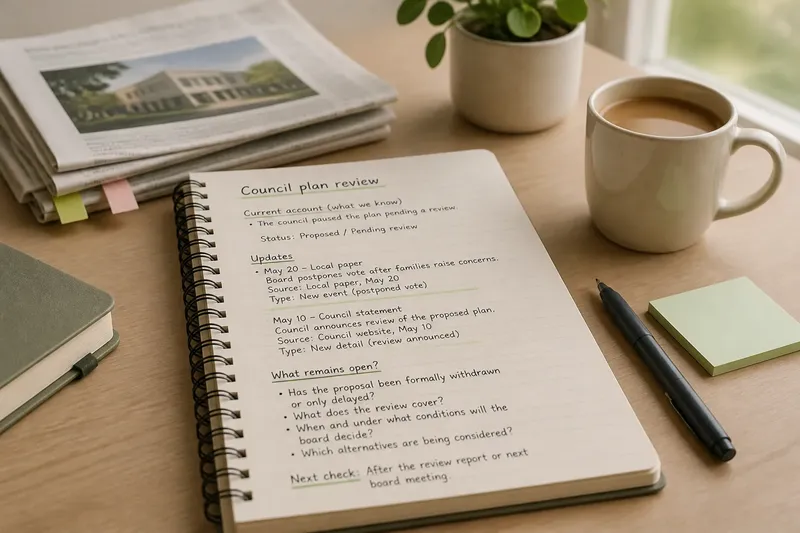
For the paused council plan, you might ask: Has the council formally withdrawn the proposal, or only delayed it? What does the review cover? When or under what conditions will officials decide what happens next? These questions do not assume that the plan will return or disappear. They mark the information still needed to tell those possibilities apart.
Separate unknowns from disagreements. If two sources describe a decision differently, record the difference and identify what each says it is relying on. If no source has reported the outcome because it has not occurred, that is an open question, not evidence of concealment or failure.
How do you keep an ongoing news story open in your notes?
Use one running note for the story rather than treating each article as a separate ending. A compact record can preserve what changed, what supports the claim and what is still pending. Keep the entries dated in ordinary language, such as “Monday morning” or “after the public meeting”, if the exact time is not central to your reading.
- Give the story a neutral working title. Use the event or issue, not a conclusion. “Council plan review” is less likely to bake in an outcome than “Plan cancelled”.
- Write the current account in one sentence. State only what the available report supports, and retain qualifiers such as “proposed”, “temporary” or “pending review”.
- Record the source for each important claim. Include the outlet or document, the relevant speaker or organisation, and the date you encountered it. Keep a link or a short identifying note so you can return to the source.
- Add the update as a separate entry. Do not erase the earlier account. A new line lets you see whether the story changed, narrowed or simply gained another explanation.
- List what remains open. Phrase each item as a question that later reporting could answer. Mark it as unanswered rather than filling the gap with a guess.
- Set a reason to revisit the note. For example, return when the review is published, a meeting takes place or a named decision is due. If no such point is reported, check for a substantive new development when you next encounter the story.
Imagine you are following a school board’s proposed change to bus routes. A new report says the board has postponed its vote after families raised concerns. Your note records the postponed vote as the update, retains “proposed change” as the current status, and leaves the final route decision open. When you see a later report, you can compare it with that record instead of relying on the impression left by the first headline.
Think of the note as a bookmark, not a verdict. A bookmark keeps your place without claiming the book has ended.
Which questions help you judge whether an update closes the story?
Does a pause mean the decision has been cancelled?
Not by itself. Look for a formal withdrawal or another clear statement of what happens to the proposal, rather than treating delay as a final outcome.
When should I look for another update?
Use a reported next event, deadline or decision as a natural point to check again. If none is given, return when you encounter credible coverage that appears to add a substantive change.
What if new reports disagree?
Keep both accounts in your note, attributed to their respective sources, and identify the point of disagreement. Look for the underlying statement, record or decision where available before treating either version as settled.
Can a story be closed if no more information appears?
You can stop following it, but that is different from knowing its final outcome. Mark the last confirmed position and the unresolved question so your own stopping point does not become a claim about what happened.
How can you avoid turning the note into a running rumour?
Keep a clear boundary between reported information and your own inference. A simple pair of labels—“reported” and “question”—can help. Under “reported”, put claims tied to an identifiable source; under “question”, put matters that remain unresolved. If you add an interpretation, label it as yours and say what detail prompted it.
Do not copy every reaction into the record. Social posts and commentary may point you towards a statement or document, but repetition does not settle whether a claim is accurate. If a reaction matters to the story, note who made it and whether it reports a new action or expresses an opinion.
When the reporting depends on a label, the wording of an official notice or a local rule, check the original material and its scope where you can; seek qualified advice if the matter affects a consequential personal decision. For ordinary story tracking, the essential habit is to preserve what the source actually says rather than enlarging it.
When is it reasonable to call the account settled?
Use a modest standard. The specific question you were tracking should have a clear answer from an identifiable source, and the answer should not depend on treating a proposal as a decision or a temporary measure as permanent. If important details remain disputed or pending, keep that qualification in the note.
Sometimes the account will remain incomplete: a review may not be published, an institution may not explain its reasoning, or later reports may never resolve a conflict. Write that limit plainly. “No further outcome located” describes your record; it does not claim that nothing happened.
To keep an ongoing news story open in your notes, record the development, preserve its source, and leave unanswered questions visible. The next time a headline sounds conclusive, compare its strongest verb with the actual decision described in the report. That small check can help you recognise an update as a new page in the account, rather than an ending it has not yet earned.