Before the Hashtag: How Labels Gather Meaning
See how public labels gather associations through repetition, and choose a careful way to read their changing implications across groups and time.
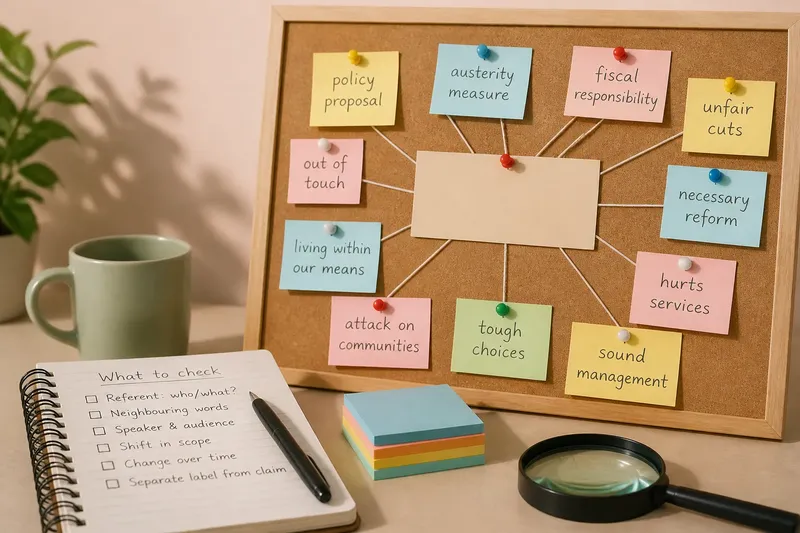
A headline calls a council proposal “austerity”; a neighbour uses the same word for a household budget. The letters match, but the implications do not. Public labels gather meaning as people repeat them, attach them to events and use them to draw boundaries. Reading a label well means asking not only what it denotes, but what history its use is inviting you to hear.
How does a public label acquire its associations?
A label may begin as a compact description: a name for a policy, movement, group or style of argument. Repetition makes it easier to recognise, but repetition alone does not fix its meaning. Each use places the word beside particular people, actions and judgements. Over time, those neighbours become part of what the label suggests.
Public debate accelerates this process. A phrase may appear in a speech, a news report, a campaign slogan and a social media post, each carrying a slightly different purpose. One speaker may use it to classify; another may adopt it proudly; a third may use it to criticise. The word keeps a shared reference while accumulating competing tones.
This is why a label resembles a well-used noticeboard rather than a dictionary entry. The printed heading stays in place, while new notes are pinned beside it. A reader who sees only the heading can miss which associations have gathered there, and who placed them.
Which reading approach suits the question?
There are three useful approaches, and none is sufficient for every purpose. Choose according to the question in front of you: what does the term mean here, how did it acquire that sense, or who is using it to define whom?
Should you start with the current use?
Read the surrounding sentence and identify the immediate referent: a policy, an organisation, a conduct or a broader group. This suits readers trying to understand a fast-moving report without importing assumptions from older uses. It clarifies what the writer appears to mean, though it may leave the term’s accumulated emotional charge unexplained.
Should you trace the word’s history?
Follow the label across earlier and later uses, noting when its referent or tone shifts. This suits readers comparing coverage over time or trying to understand why a familiar term has become contentious. A historical trace can reveal change, but it should not be mistaken for a single, tidy origin story: public language often develops through overlapping uses.
Should you examine who applies the label?
Compare self-description with outside description: who adopts the term, who rejects it, and who has the authority to make it stick in a particular setting? This suits readers studying political boundaries and public identity. It brings power and audience into view, but it can distract from the underlying claim if every word is treated only as a tactic.
Why can the same label imply different things?
Meaning depends on more than a word’s broad definition. The speaker’s relationship to the subject, the audience’s prior knowledge and the setting all affect what a label implies. A term used within a group may signal shared identity; used by an opponent, it may sound like an accusation. A newsroom may use it as a category while readers hear a judgement.
Implications also change as events alter the associations around a word. A label once used mainly in neutral description may acquire praise, stigma or irony through repeated public arguments. Conversely, a term with a hostile history may be reclaimed by people it was used against. Reclamation does not erase earlier meanings; it adds another live possibility, whose force can vary by speaker and audience.
Imagine a fictional neighbourhood group that calls itself “residents’ action” while organising around a proposed traffic change. A local columnist later uses the same phrase to describe a wider campaign, and some readers understand it as civic participation while others hear a challenge to the council. The observable difference is not a new dictionary definition but a changed referent and audience. Checking who is included in each use helps separate the group’s own name from the broader impression attached to it.
What should you check when a label feels loaded?
- Find its referent. Ask exactly which people, actions or ideas the word names in this passage.
- Read the neighbouring words. Notice whether the label sits beside praise, blame, a quotation or a factual description.
- Identify the speaker and audience. A self-chosen name and an opponent’s name may carry different stakes.
- Look for a shift in scope. Check whether the term moves from one organisation or policy to a much wider population.
- Compare uses across time. Ask whether the referent, tone or typical setting has changed, rather than assuming the word has one permanent sense.
- Separate the label from the claim. Restate what is being asserted in plain terms, then assess that assertion on its own.
These checks are most useful when a headline relies on a compact label to carry an argument. They also help readers avoid the opposite mistake: treating every use as an attempt to manipulate. Sometimes a familiar term is simply the clearest name available; context shows whether it fits.
When is each approach the better choice?
For a single report, begin with current use: establish what the writer is naming before weighing its associations. For a comparison across years, trace the history, using examples from the periods being compared rather than assuming the label stayed stable. For a dispute over identity or authority, examine who applies the word and how the people described respond.
These approaches can be combined, but order matters. If you start with the word’s most charged historical meaning, you may force that meaning onto a passage where it does not fit. If you stop at the immediate definition, you may overlook why the choice of label matters to readers. A brief first reading can establish the local sense; a second can test what the wider history adds.
Before the hashtag, then, is a useful moment to pause—not because a label must be avoided, but because its meaning is made in use. For any public label, note its referent, speaker and audience before deciding what associations belong to this particular passage. That small distinction lets you read a changing word without confusing its history with the claim being made now.