One Story, Three Reading Passes
One story, three reading passes help you separate a news claim from its support and record what remains unanswered before sharing or relying on it.
You open a news story while waiting for the kettle, then notice that its headline makes a sweeping claim about a council decision. One story, three reading passes gives you a way to slow that first reaction: identify the claim, inspect its support, then note what the story leaves unresolved.
This routine is for a particular occasion, not a demand to treat every article as a research project. It is useful when a report may shape a conversation, a decision or your understanding of a developing issue. Each pass has a separate job, so you are less likely to let a vivid detail stand in for the whole argument.
What is the purpose of three reading passes?
The purpose is to distinguish what a story says from why it says it and what you still cannot tell. Reading once can blur those questions together. A second, more deliberate look gives the claim and its support different places in your attention; a final note keeps uncertainty visible.
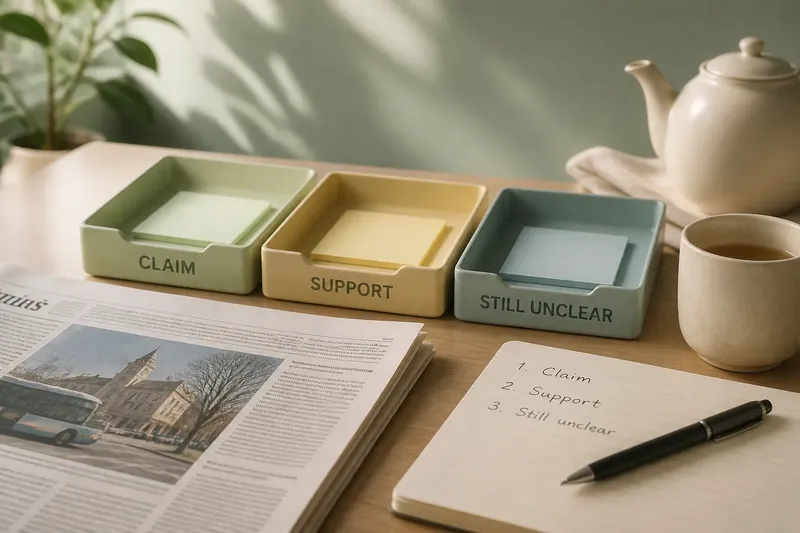
Think of the passes as three trays on a desk. A document belongs in the tray that describes it: claim, support or unanswered question. The analogy is simple, but the separation matters. A quotation may support one narrow point without establishing a headline’s broader wording.
You need not use the routine on every item in a feed. Choose a story when its central claim seems consequential, unusually broad, or hard to assess from the headline alone. For a brief notice with little bearing on your choices, ordinary reading may be enough.
How do you identify the main claim?
On the first pass, ask what the article wants you to believe happened, is happening or is likely to happen. Read the headline, opening and closing paragraphs, then locate the sentence that states the central assertion most plainly. Do not treat the headline as the claim automatically; the article may qualify or narrow it in the body.
Write the claim in one sentence using language no stronger than the report itself. Preserve its scope: who or what is involved, where, and over what period, if the story specifies those things. If the article presents a proposal, do not rewrite it as an approved decision. If it reports an allegation, keep the allegation attached to its source.
Say you are reading a local report that says a school board’s proposed timetable could change the afternoon bus service. Your first-pass note might be: “The board is considering a timetable change that may affect afternoon buses.” That wording does not turn a proposal into a settled change, nor does it imply every route is affected.
Mark any terms that carry more meaning than the article defines, such as “record”, “surge” or “crisis”. They may be justified, but the first pass is not the time to decide. Simply note that the wording needs checking against the story’s evidence and context.
What should you check on the support pass?
On the second pass, ask what in the article supports the claim you wrote down. Look for named documents, direct observations, attributed statements, data, and the methods or limits attached to them. Then ask whether each item bears on the same claim, rather than merely appearing near it.
Make a small note with two columns: “support offered” and “what it supports”. A council document might establish that a proposal exists; it may not establish its likely effect on every passenger. A resident’s account can describe an experience, but cannot by itself show how common that experience is.
Pay attention to how evidence is presented. Does the story identify where a figure came from? Does a quoted person have relevant knowledge, or are they expressing a view? Are comparisons made across similar periods or groups? These questions do not require you to dismiss the report. They help you judge how far its evidence reaches.
Also notice the difference between a source and an interpretation. A report may quote an official describing a policy as “successful”, while the underlying document records only that the policy began. The quotation is evidence that the official made the claim; it is not, by itself, evidence that the claimed outcome occurred.
What questions should you ask before you stop?
Does the evidence support the headline’s full wording?
Compare the headline’s breadth with the evidence in the body. If the reporting supports a narrower claim, keep that difference in your notes rather than silently treating the two as equivalent.
Who is quoted, and what can they know?
Separate first-hand knowledge, professional or official responsibility, and personal opinion. A source may be well placed to speak about one aspect while having limited access to another.
What context would change how I read this?
Look for relevant scope, timing, comparisons and earlier decisions that the story itself mentions or points towards. If the article gives no way to assess a broad comparison, record that gap rather than filling it with an assumption.
What remains unanswered by this report?
Write down the most consequential unknown, not every detail you would like to know. A clear unanswered question might be whether the proposed bus timetable has been approved, or which routes would change if it were adopted.
How do you record what remains unanswered?
Use the third pass to make a short “still unclear” note. State what the article establishes, then name the missing information that limits a conclusion. This is not a verdict on whether the story is true; it is a boundary around what you can responsibly take from it.
For the bus report, the note could read: “The board is considering a timetable change. The article does not say whether it has been approved or identify the routes affected.” That record separates a reported proposal from its possible consequences and gives you a precise question to revisit if more information appears.
When a detail matters to a decision, choose a sensible next move: look for the board’s published agenda, read a linked document, or wait for a report that addresses the missing point. Do not keep searching merely to make uncertainty disappear. Sometimes a story does not yet contain the information you need.
When is this routine useful, and when can you stop?
Use the three passes when the distinction between a claim and its support could affect what you repeat, believe or do. It can be particularly useful with reports about proposals, disputed accounts, preliminary findings or sweeping headlines. It is less useful as a ritual applied to every small update.
Stop when you can state the central claim fairly, describe the support the article offers, and name the most important unanswered question. You do not need to settle every uncertainty to read well. The point is to avoid giving a story more certainty or reach than its contents warrant.
One story, three reading passes is therefore a compact record of your reasoning, not a score for the article. If you return to the report later, your notes show which parts were stated, which were supported and which still depended on information the article did not provide.